Names instead of code numbers
The text report identifies each ingredient by a code number. RustPEP searches more than 1,000 ingredients by name and shows formula, density and heat of formation as you browse.
Software · Propellant evaluation for rocket motor design
A complete rewrite of the classic PROPEP program in Rust, with a modern desktop interface for Windows and Linux. Enter a propellant recipe and get chamber temperature, specific impulse, characteristic velocity and combustion products, ready to carry into BurnSim.
Then and now
PROPEP answers with a text report. RustPEP is a complete rewrite in Rust with a modern desktop interface, built for the future. It runs on Windows and Linux, and a macOS version is planned next.
Classic PEP text report
  CODE                                   WEIGHT    D-H  DENS      COMPOSITION
   137 AMMONIUM PERCHLORATE (AP)         68.000   -602  0.07040    1CL  4H   1N   4O
   845 R45 HTPB (UTC)                    20.000      5  0.03360  981H 654C   6O
    63 ALUMINUM (PURE CRYSTALINE)        12.000      0  0.09760    1AL

THE PROPELLANT DENSITY IS 0.05938 LB/CU-IN OR  1.6436 GM/CC
  …
**********PERFORMANCE:  FROZEN ON FIRST LINE, SHIFTING ON SECOND LINE**********

 IMPULSE   IS EX      T*      P*      C*    ISP*  OPT-EX  D-ISP      A*M   EX-T
   248.8  1.2204    2473   38.08  4987.5            8.43  408.8  0.15505   1283
250.8 1.2023 2506 38.41 5022.7 193.3 8.56 412.2 0.15615 1326RustPEP
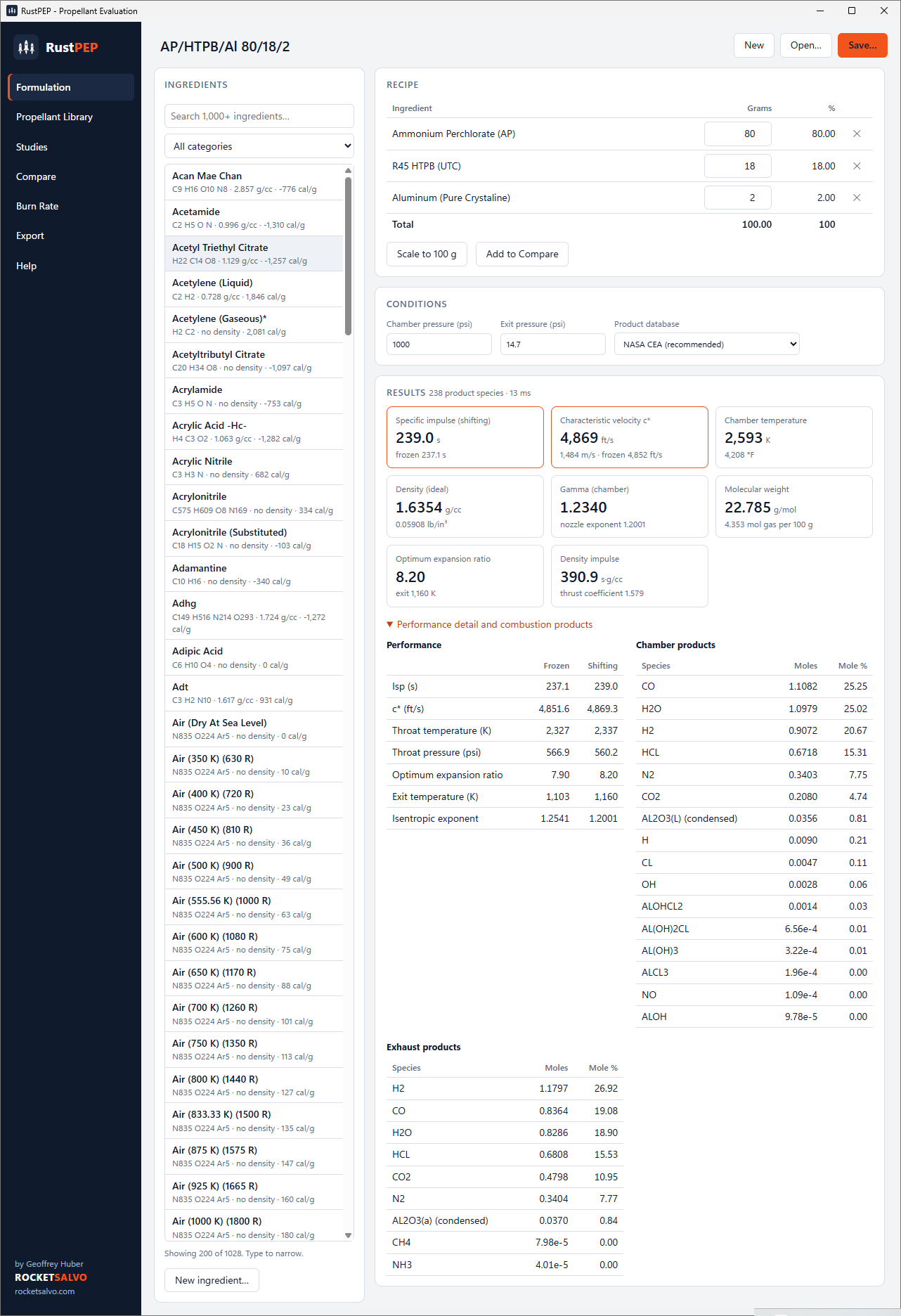
The text report identifies each ingredient by a code number. RustPEP searches more than 1,000 ingredients by name and shows formula, density and heat of formation as you browse.
Specific impulse, c*, chamber temperature, density and gamma appear as named values with their units, and recalculate as you type.
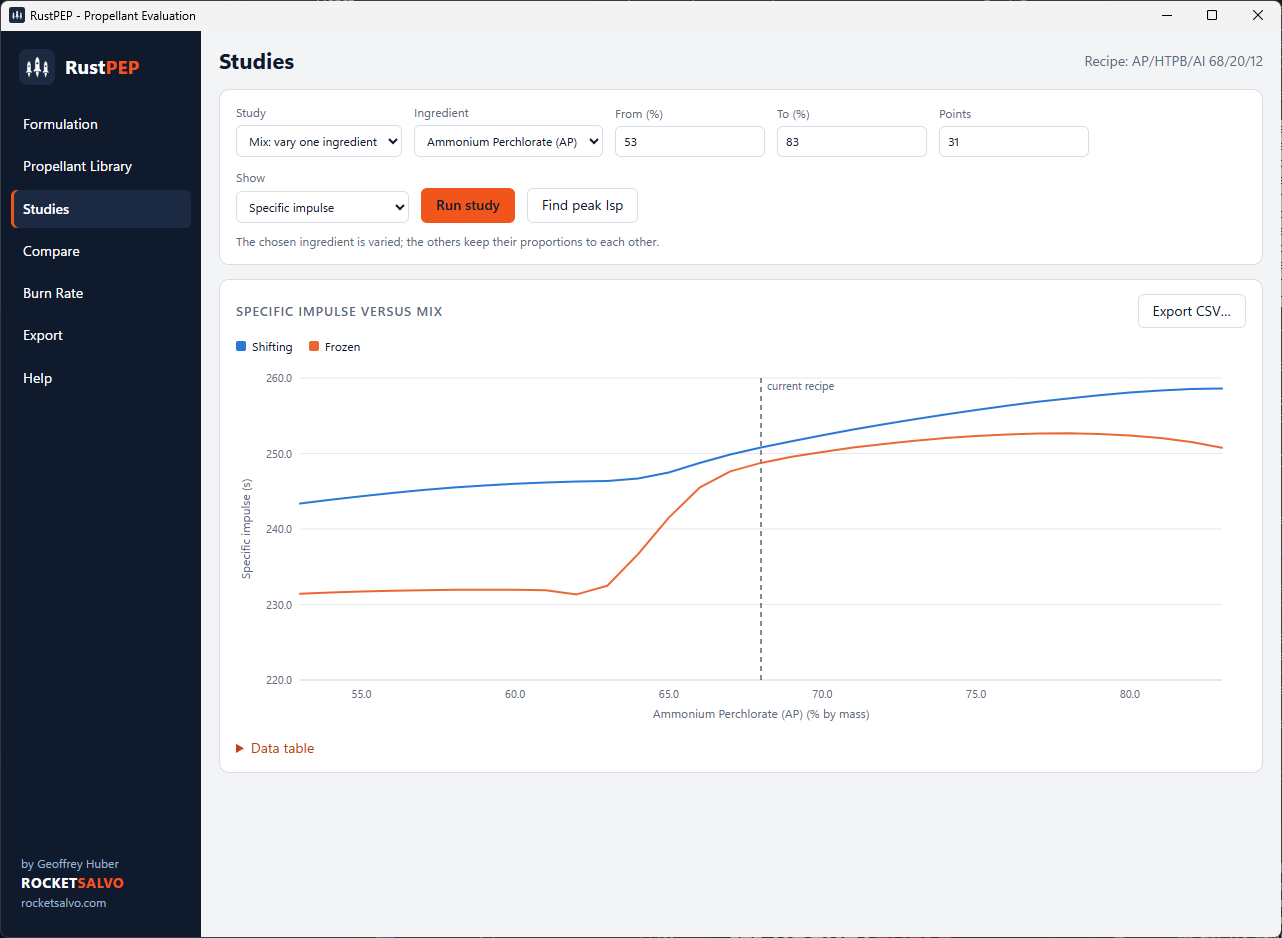
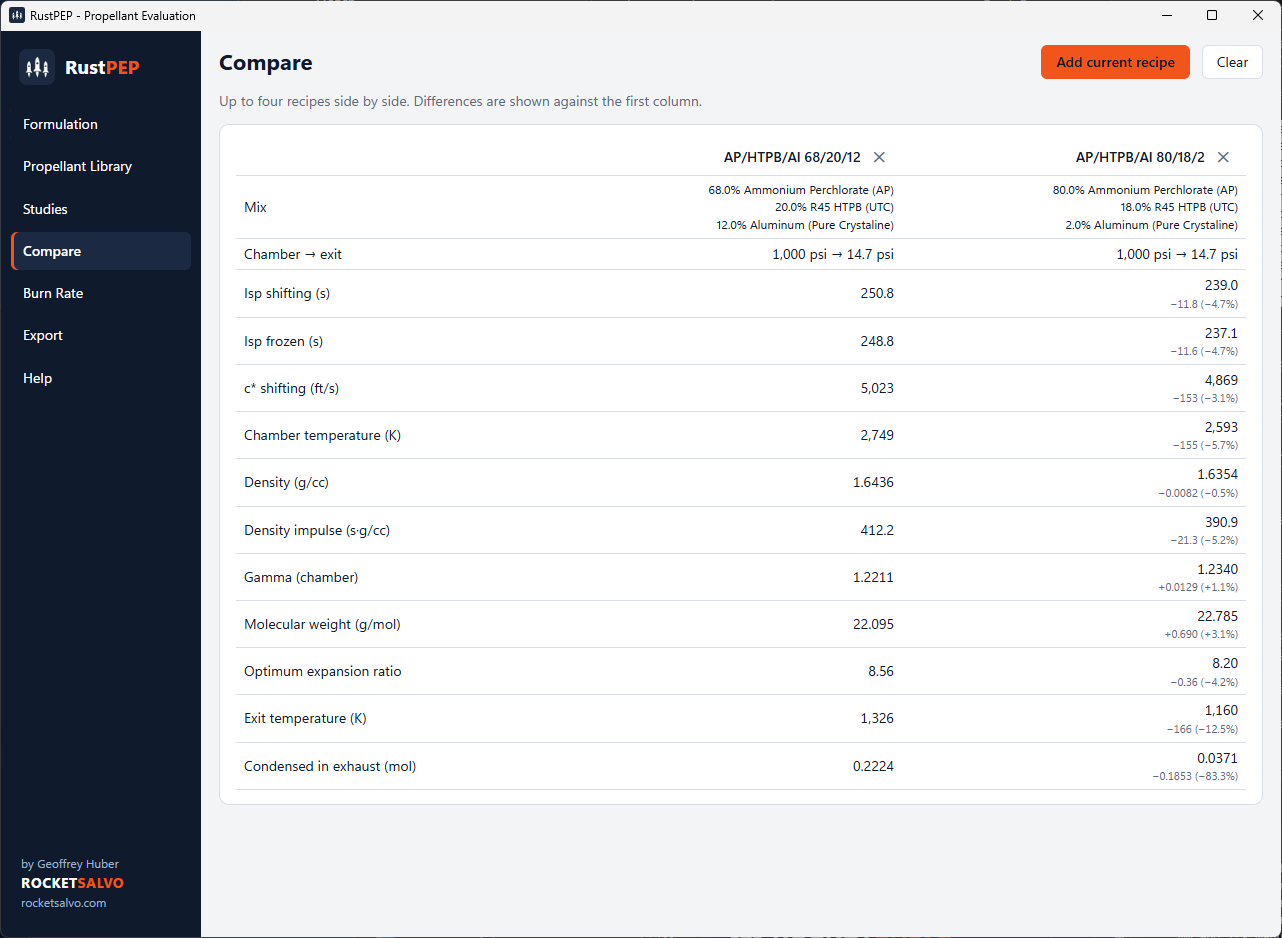
One report describes one recipe at one condition. RustPEP sweeps a variable and charts it, compares recipes side by side, and fits burn rate from test firings.
What it does
01
Chamber temperature, specific impulse (frozen and shifting), characteristic velocity, density, gamma, molecular weight and combustion products for a propellant recipe.
02
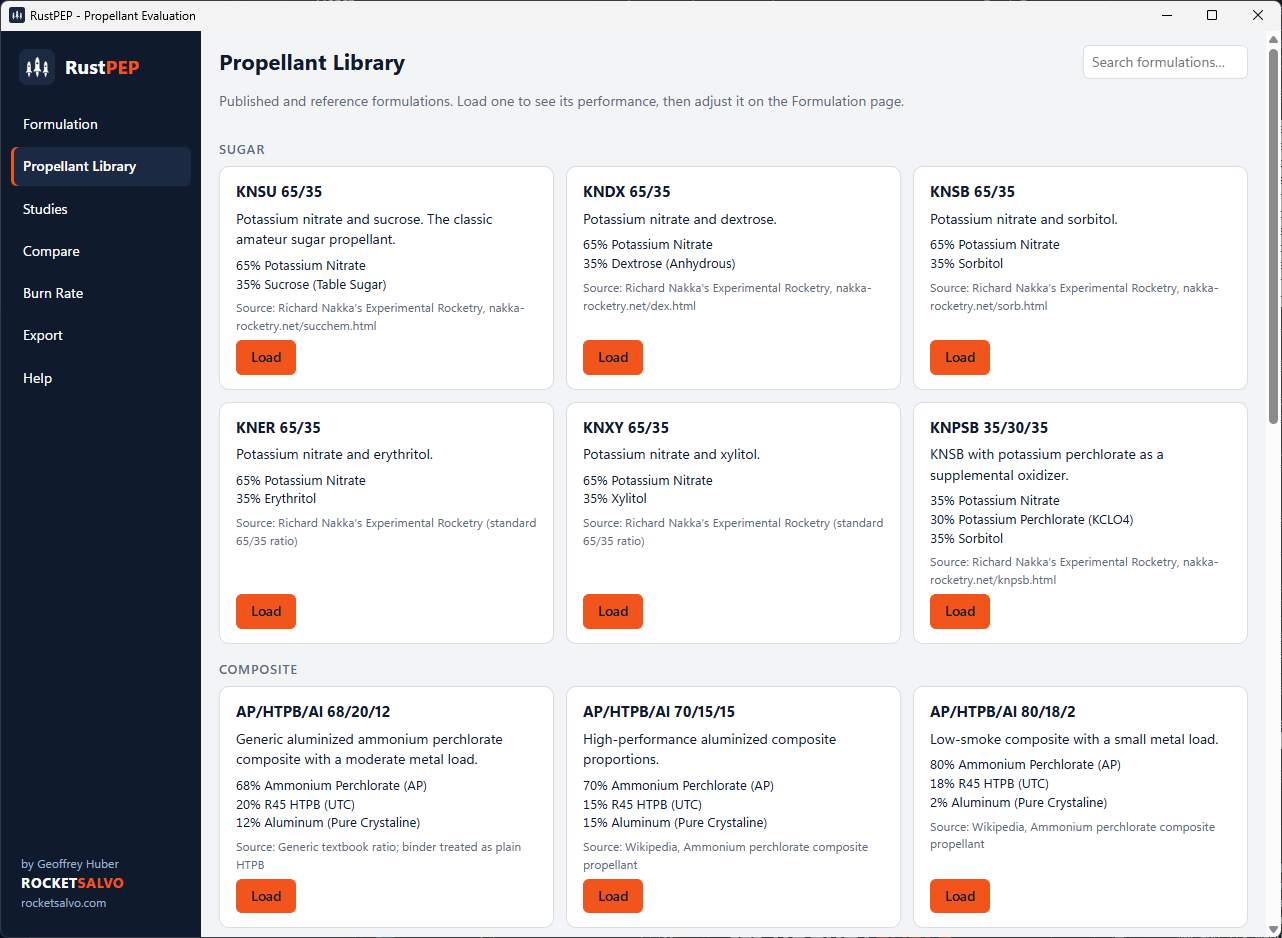
More than 1,000 ingredients from the PEPCODED file, your own custom ingredients, and a library of published reference formulations to load and adjust.
03
Sweep one ingredient, chamber pressure or nozzle expansion ratio and chart the result. A peak-Isp finder locates the best percentage in a range.
04
Compare up to four recipes, with differences shown against the first column.
05
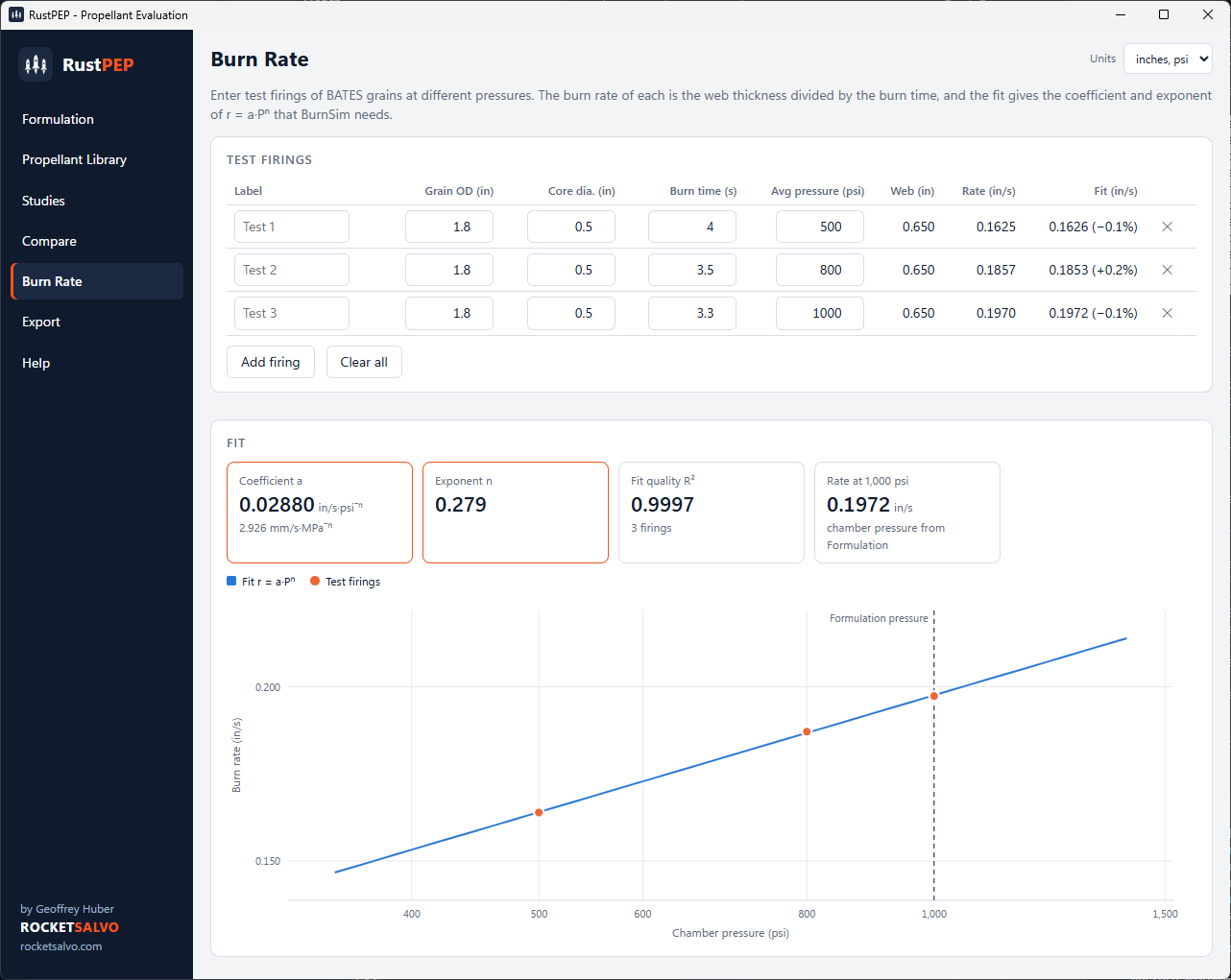
Enter BATES grain test firings at different pressures and fit the coefficient and exponent of r = a·Pⁿ.
06
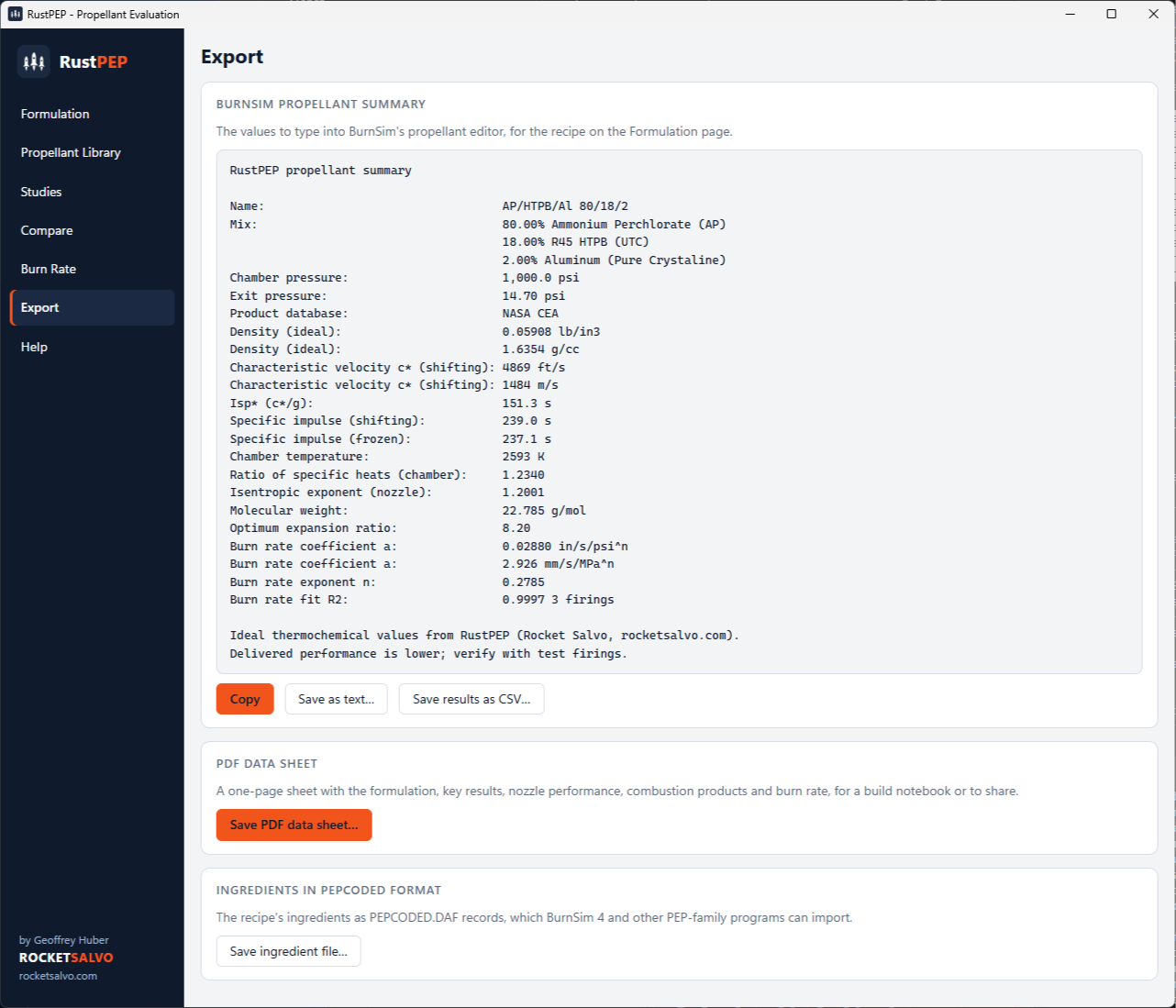
A BurnSim propellant summary to copy or save, results as CSV, a one-page PDF data sheet, and ingredient files in PEPCODED format.
A look around
Specifications
| Application | |
|---|---|
| Current version | 0.1.0 |
| Platforms | Windows, 64-bit (x64); Linux, 64-bit (x86_64) |
| Minimum Windows version | To be determined |
| macOS | Planned; no release date set |
| Windows packages | Setup program (.exe), MSI installer, portable .zip |
| Linux packages | Debian package (.deb), RPM package (.rpm) |
| Command-line runner | Part of the project; packaging not finalized |
| Calculation | |
|---|---|
| Method | Chemical equilibrium, ported from the Naval Weapons Center Propellant Evaluation Program (PEP) |
| Product databases | NASA Glenn CEA (default); legacy JANNAF 1986 for PROPEP-compatible results |
| Ingredient data | PEPCODED file, 1,000+ ingredients, plus user-defined ingredients |
| Studies | Ingredient mix, chamber pressure, nozzle expansion ratio; peak-Isp finder |
| Burn-rate model | r = a·Pⁿ fitted from BATES test firings |
| Output | |
|---|---|
| Units | Imperial and SI on the burn-rate page; pressures entered in psi |
| Export formats | BurnSim summary (text), CSV, PDF data sheet, PEPCODED ingredient records |
Credits and data sources
BurnSim is a separate program by its own author. RustPEP exports values for use in it and is not affiliated with it.
Version 0.1.0 for Windows and Linux.