RustPEP
Propellant design, from recipe to mix sheet
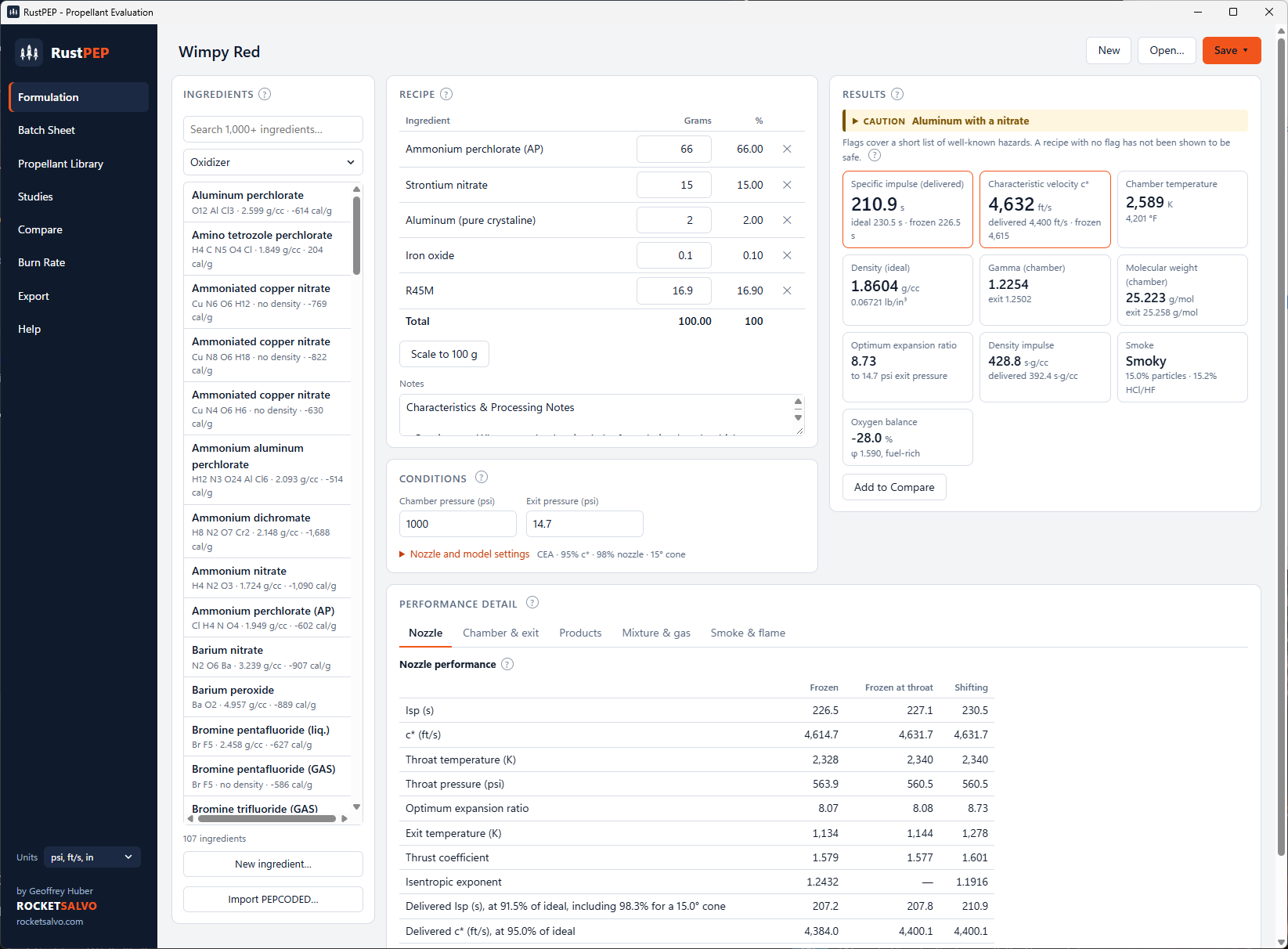
A propellant workbench for people who make their own motors. RustPEP predicts the performance of a recipe, fits burn rate from your test firings, sizes the nozzle throat, writes the batch sheet for the mix and sends the finished propellant to BurnSim and openMotor. It began as a rewrite of the classic PROPEP program and still reproduces its results. It also covers chemistry PROPEP does not, such as bismuth, with results checked against the Air Force AFCESIC code.
- Isp, c*, chamber temperature, density and gamma for any recipe
- Burn rate from your own firings, then Kn and throat sizing
- Batch sheet with cost, curative calculator and batch log
- Sends propellants straight to RustCore, BurnSim 4 and openMotor
RustCore
Motor core and grain design
Design the grains and core of a solid rocket motor, then let RustCore’s Studies optimize the geometry for performance and safety: the most impulse, or another goal, with mass flux, chamber pressure and port-to-throat ratio held inside your limits through the whole burn. Bring the propellant straight from RustPEP with its measured burn rate, and export the result to openMotor or BurnSim. Round, star, finocyl, moon and D grain cores, straight or tapered, and end burners. It is in beta.
- Studies find the core with the most impulse, or another goal, inside your flux, pressure and port-to-throat limits
- Propellants straight from RustPEP, with their burn-rate fit and test firings
- Round, star, finocyl and moon cores, straight or tapered, mixed in one grain, plus D grains and end burners
- Pressure, thrust, Kn and mass flux along the motor through the whole burn
- Exports to openMotor, BurnSim and RASP .eng, and the mandrel as STL or STEP
RustCase
Motor hardware, from case tube to proof test
Designs the hardware a solid motor is built in: the case tube — machined metal or filament-wound composite — the forward closure, the aft closure that carries the nozzle, what retains them, and their O-rings. It checks every part against the motor’s pressure and heat, gives the case a rated maximum operating pressure, writes the hydrostatic proof-test procedure, and exports the parts for a machine shop with a bill of materials. Engineering estimates for amateur and research motors, not a pressure-vessel code. Coming soon.
- A rated MEOP, with the basis it was arrived at written down
- Around forty checks with margins: tube, screws, snap rings, threads, closures and O-rings
- Filament-wound carbon or glass tubes, checked for fibre burst, weep and resin temperature
- Wall temperature through the burn and the soak after burnout, with strength loss to match
- STEP, DXF, STL and PDF drawings for a machine shop, with a bill of materials
- Not a pressure-vessel code: proof test every case with water before you fly it
RustStand
Static test capture, from load cell to a and n
Static test capture for solid rocket motors. A Raspberry Pi at the test stand records thrust, chamber pressure and video, starting and stopping on its own as the motor lights and burns out, while RustStand apps on your phone and computer watch and control it over WiFi. Every test gives impulse, motor class, burn time and chamber pressure, plus the burn-rate points that fit good a and n values for RustPEP. Measurement only: it never controls ignition. Coming soon.
- Measured a and n for RustPEP, fitted from your own static tests
- Starts and stops recording on its own as the motor lights and burns out
- Thrust, chamber pressure and high-speed video on one clock
- A Raspberry Pi at the stand, run from your phone or computer over WiFi
- Measurement only: it never controls ignition
Electronics
In developmentMAD
Magnetic Apogee Detector
A modern interpretation of Robert Galejs’ magnetometer-only apogee detector. MAD senses the rocket’s orientation against the Earth’s magnetic field to detect apogee. It is prototype hardware under development and is not flight qualified.
- Magnetometer-only apogee sensing
- Hardware arm jumper that firmware cannot bypass
- On-board flight logging with USB-C retrieval
- Rev A prototype: not flight qualified, not for sale