01
Studies: optimize for performance and safety
Tick the dimensions that may change, pick a goal (most impulse, most propellant, lowest peak flux, flattest thrust curve, a target impulse, longest burn or a target burn time) and the limits that must hold, and Find the best searches for the core. Every candidate is a full burn simulation, kept under your mass flux and pressure limits and above your port-to-throat minimum. Sweep one setting for a chart, or two for a map.
02
Propellants from RustPEP
Fit the burn rate from your test firings in RustPEP, then press Add to RustCore library on its Export page. The propellant arrives with its density, burn-rate fit, c* and efficiency, gamma, flame temperature, molar mass and the firings themselves, ready to pick on RustCore’s Propellant page. Refit it in RustPEP and add it again to update it.
03
Mix-and-match cores
A grain’s core is a chain of sections, each round, star, finocyl or moon, and each straight or tapered, so a taper at the head end and a finocyl at the nozzle end can be one grain. A D grain, a flat slot down the grain that can also taper, takes a grain to itself. An end burner starts with a solid section and burns from its nozzle end only, which can be flat or have a cone or drilled hole for more thrust at ignition. Grains stack, and each end face either burns or is inhibited. Moon and D-grain cores are drawn in cross-section to scale as you set them, with sliders that move the offset live and the web thicknesses written out.
04
Mass flux down the core
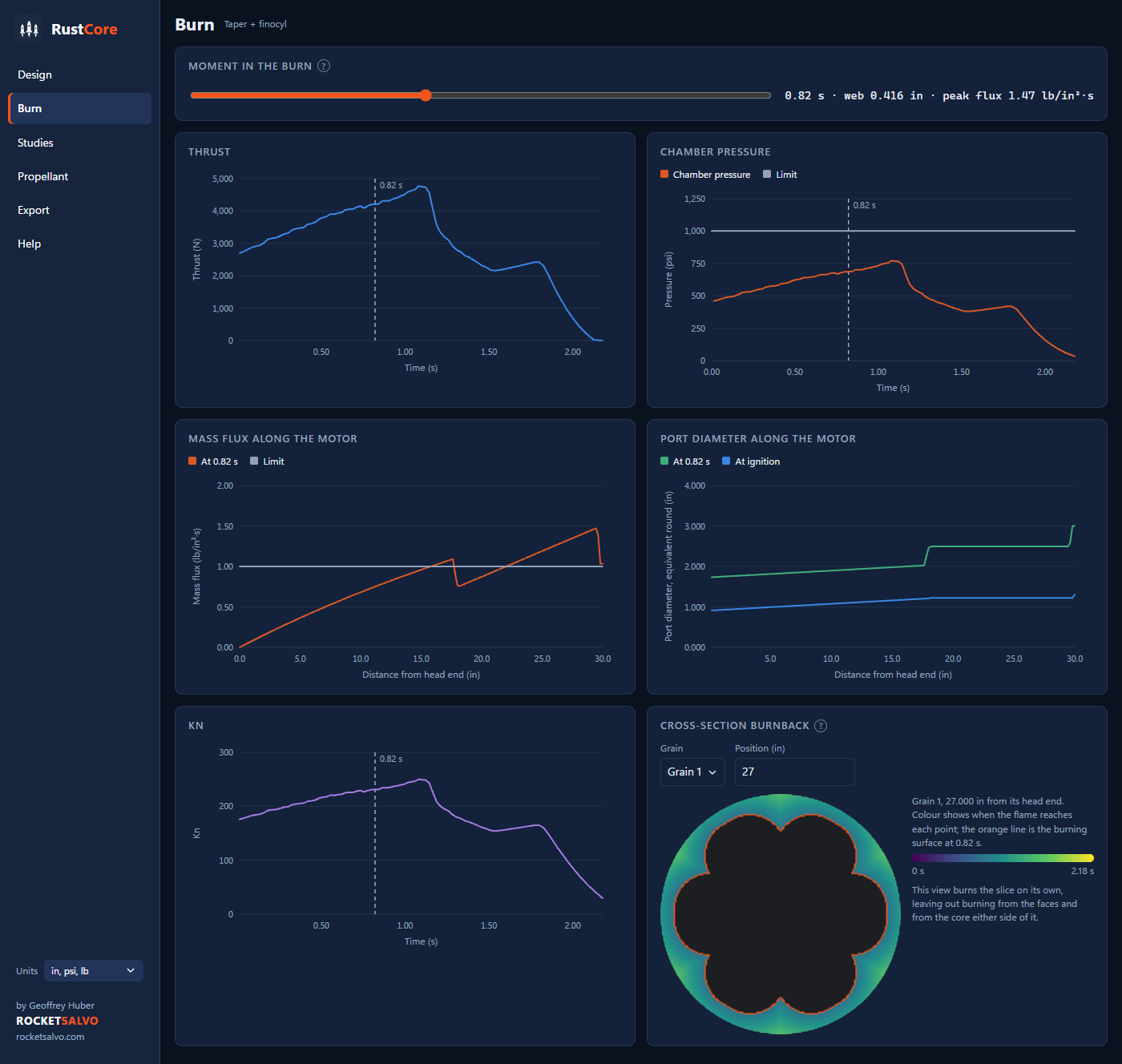
Gas made along the core funnels toward the nozzle, so in a long motor the mass flux climbs toward the aft end, and above a threshold erosive burning sets in. RustCore charts the flux along the motor at ignition and at its worst during the burn, against your limit, and gives the smallest aft port that holds it.
05
Erosive burning, predicted and explained
The Design page shows every result twice when you ask it to: the standard simulation, and beneath each number the same motor with erosive burning — designation, peak pressure, mass flux, burn time and peak thrust, with how far each moved. The limit check judges both, so a motor that stays under its case rating only because erosion was left out is flagged. Once predicted, the erosive figures follow your changes until you press Stop. Before that, the page says plainly that its numbers leave erosion out, and more firmly as the mass flux nears your limit. A prediction is not the baseline with bigger numbers: erosion is worst near the nozzle, so that end burns through first, and the peak pressure can come out lower than the no-erosion figure while the motor is in worse shape. The Burn page has the full picture: the burn rate along the core, both curves drawn together, and a checklist of what the chosen method still needs, where every missing input has somewhere to go — nothing is ever reported as having no place to enter it. Where that input is a propellant property only RustPEP can supply, **Open in RustPEP** takes you straight to that field of the recipe in RustPEP, on the right page with the entry box already open; it needs an installed RustPEP 0.64 or later that has been started once, since the portable copy does not register the link and the button stays hidden there. One button calibrates a method against your own erosive firings or validates it, whichever the method calls for. Research only — no method’s citation has been checked against its source paper, and fitting a method to your data does not establish that it describes a motor. Confirm by static test before you design around it.
06
Full burnback and ballistics
Chamber pressure, thrust, Kn and the flux at every station along the motor, step by step through the burn, with the motor class, total impulse and delivered Isp. Move a slider through the burn to see the port and a slice of the grain burning back.
07
Throat sized for you
Let the throat size itself for a target peak Kn, starting Kn or peak pressure while you shape the core, so every core is compared at the same Kn. Switch to a fixed diameter once you have a real nozzle.
08
Constant-flux taper
Reshape a round core into short tapers that bring the worst flux to the same target at every point along it. Use it to see the ideal shape, then simplify it to a double taper you can make.
09
3D model and casting mandrel
A live 3D model with grain, cutaway and mandrel views. A double-taper core cannot be pulled out in one piece, so RustCore splits the mandrel where each piece can slide out of its own end, or says to use a lost core. Save the grains or the mandrel as STL or STEP.
10
Export to motor simulators
Save the whole motor as an openMotor .ric file, which BurnSim 4 also opens, or as a BurnSim 3 .bsx file. Also a RASP .eng thrust curve for OpenRocket and RockSim, and CSV. Every export lists anything it had to approximate.
11
Other propellant sources
Import a propellant from openMotor’s library or a .ric motor, or from BurnSim’s propellant list or a .bsx motor. A design keeps its own copy of its propellant, so changing the library never changes a saved motor.