MAD documentation
Overview and status
What MAD is, how it detects apogee, and where the prototype stands.
Prototype hardware. Not flight qualified. An electric-match firing circuit can cause fire or injury. These notes describe a design under development. They are not assembly or operating instructions, and nothing here should be used to fly the unit.
What MAD is
MAD, the Magnetic Apogee Detector, is a modern interpretation of Robert Galejs’ magnetometer-only apogee detector, designed by Geoffrey Huber for RocketSalvo.
A magnetometer measures the Earth’s magnetic field along the rocket’s long axis. As the rocket arcs over at apogee, its orientation relative to that field changes, and the firmware uses that change as the apogee cue. Orientation is the sole apogee cue. The MAD product page has diagrams of how this works.
Rev A at a glance
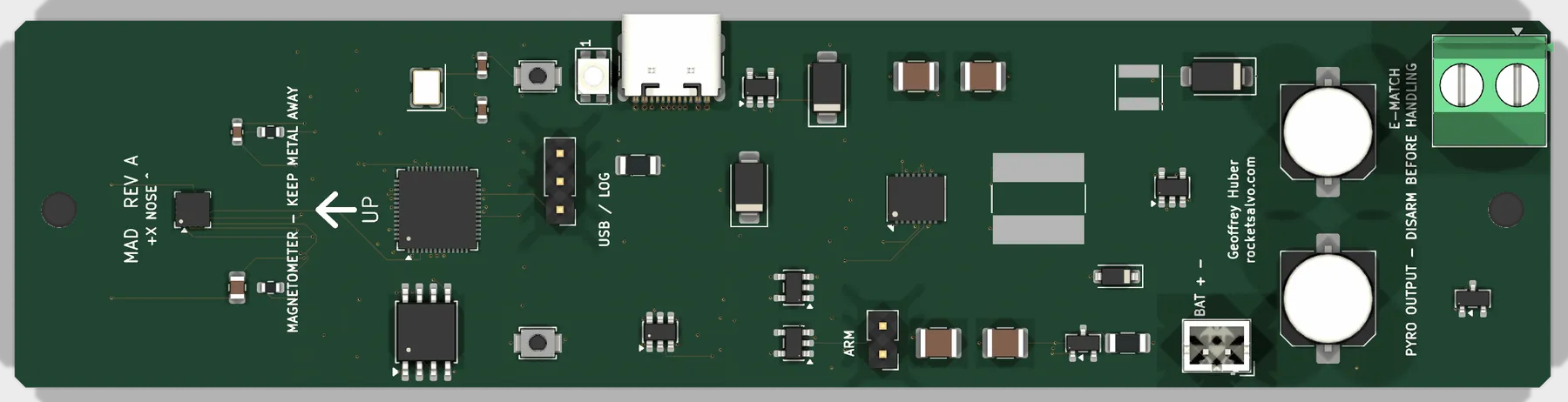
The picture is a 3D render from the PCB design files, not a photograph of a built board.
- Accepts 3–18 V, including a single-cell LiPo
- Senses orientation with an MMC5983MA magnetometer
- Logs flight data to a 16 MB flash device
- Exposes USB-C for configuration and log retrieval
- Uses stored energy to drive one electric match
- A removable ARM jumper is part of both the charger-enable and fire-enable hardware paths; firmware cannot bypass it
Specifications that are not finalized, including board dimensions, mass and flight envelope, are listed as open on the product page.
Status
Rev A is an engineering prototype. The schematic, a four-layer PCB layout and RP2040 firmware exist. The staged verification and qualification plan must be completed, along with an independent schematic, PCB, firmware and range-safety review, before the design is connected to any initiator or flown.
MAD is not for sale, and no availability date has been set.